Coos Bay, OR – Southwestern Oregon Community College announces the names of students who excelled fall term 2020-2021. These students are being recognized with placement on the college’s Dean’s List (DL), Honor Roll (HR) and Academic Excellence (AE) list.
• Academic Excellence – students must receive a GPA of 4.0 in at least 12 credits
• Honor Roll – students must receive a GPA between 3.5 and 3.99 in at least 12 credits
• Dean’s List – students must receive a GPA between 3.0 and 3.49 in at least 12 credits
COOS COUNTY – Students at Southwestern Oregon Community College are on the lookout for both asteroids and micrometeorites.
Dr. Aaron Coyner, associate professor of physics at SWOCC, has students participating in two new projects. The first is Project Stardust, which is searching for micrometeorites in Coos County.
“Meteorites are fragments of space debris that reach the ground and micrometeorites are much smaller,” Coyner explained. “They are essentially microscopic, similar to sand grands but slightly bigger, spherical and made largely of iron, nickel and other (metals)….”
Project Stardust got started when one of Coyner’s students, Ethyn Killinger, entered a program through the local Oregon NASA Space Grant Consortium. The program, SCOAR, is conducting research into micrometeorites in the area to find and classify them.
Coyner, volunteer researcher Krystal Hopper, and three to four students have formed a team to help with the project. One of these students also attends North Bend High School.
“We are creating collectors using designs given to me by a colleague at Oregon Coast Community College … to collect these micrometeorites from storm drains, downspouts and flat rooftops,” Coyner said. “…The experts in the field have said there is one micrometeorite per square meter that hits the planet every year.”
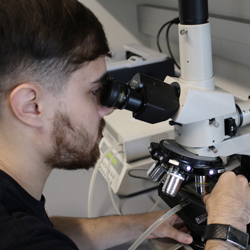
Coyner hopes the team can find these micrometeorites on flat rooftops or those that have been washed into downspouts and then extract them using a specialized magnet. From there, students will analyze them in a lab where the micrometeorites are cleaned up and analyzed under a microscope. They will be compared to ones that have been previously discovered.
“…We’re building this out so it’s a research project for one of my students but is a team effort and may evolve into a citizen science project as we move forward,” Coyner said.
Coyner said that Killinger has done research into the subject and helped identify local sites where the team will begin collecting samples. They plan on starting next week.
“We expect that our initial findings will be completed by the end of April or the first part of May because (Killinger) has to write a report by the middle of May,” Coyner said.
Looking for asteroids
The second project that Coyner’s students have started working on is the Coastal Oregon Asteroid Search Team. It is an international collaboration known as the International Asteroid Search Campaign run out of a university in Texas.
“We have special software that (the International Asteroid Search Campaign) gave us that allows us to look at images taken by Panstar’s telescope in Hawaii and look through successive frames … for asteroids and other small bodies…,” Coyner said.
The goal is to identify near-earth asteroids that may not have been seen before.
There is a total of 94 teams across the world participating in the project. Coyner said many are in India, with a few from the Middle East and South America. There are only six to seven teams in the United States and “we are one of those teams,” he said.
“(Hopper) and I heard about (the project) when we had gone to a space grant meeting a couple years ago and I had a student interested in doing astronomy data analysis,” he remembered. “I thought it would be a good project to get started but the original idea morphed.”
He turned it into a team project as a way to get students to get experience working with telescope observations and get used to the computer image processing used with the data.
“It struck me as a good learning experience and a good research project to start without having to worry about buying tons of new science equipment,” he said. “It’s something we can do with the computers at SWOCC and that students have themselves.”
In addition, the project fit in well with the current COVID restrictions that have kept students away from in-person classes.
“It’s not something that has to be done physically in a lab,” he said. “You can do this wherever you are.”
So far, he said students have been enjoying it. Though some students are “slightly overwhelmed” as they juggle online school, Coyner said “this is a fun educational break from some of the chaos that has been Zoom classes.”
He asks that if anyone in the area is interested in having the Project Stardust team do micrometeorite collection at their businesses, email him at aaron.coyner@socc.edu or Hopper at physics-engineering@socc.edu. “We’re always grateful for community support,” he said.
To learn more about physics and engineering degrees at Southwestern visit: https://physics.socc.edu/.
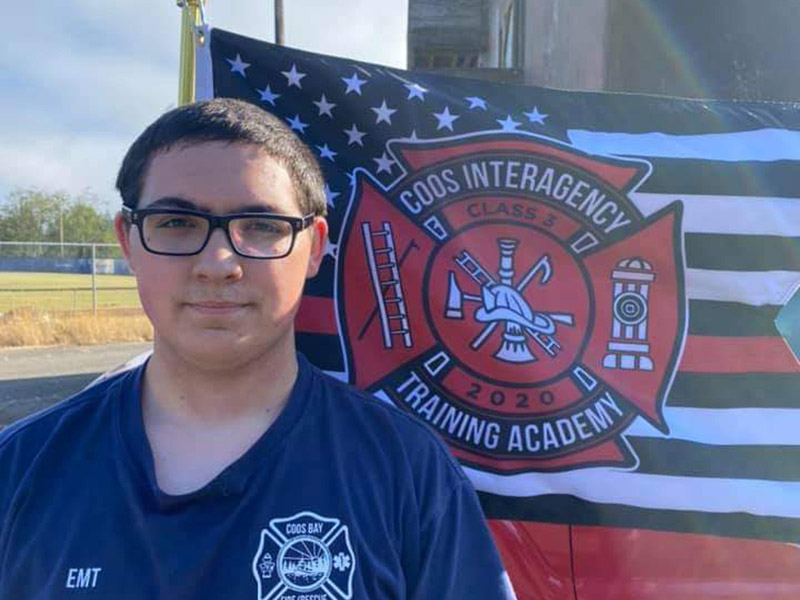
Most of us are touched by trauma at some point in our lives. Southwestern Oregon Community College student Jonathan Torres turned traumatic experiences into motivation to pursue a career in helping others. As a young man, his parents were involved in life-threatening accidents. Both would probably not be alive today had it not been for the skill and compassion of the emergency medical personnel who responded to the 911 calls. And it was the skill and compassion they showed that motivated Jonathan to pursue a career in Fire Science/Paramedicine.
The son of a Cuban immigrant, Jonathan spent his childhood in Washington and moved to Coos Bay at 11 years old. What prompted the move? The injuries that his father suffered from a head-on collision made it necessary for him to pursue a new type of employment. Jonathan’s father went back to school to study histology (the study of the microscopic structure of tissues) and moved the family of five to the region to take a position at Bay Area Hospital. The summer after the move, his mother subsequently suffered an accident while riding an ATV. Thus far, her injuries have prevented her from returning to work.
“My parent’s injuries changed our lives forever. I had to do a lot more around the house and help them with whatever they needed,” said Jonathan, who went to work when he was 16 to help with expenses. “But things could have been a lot worse! I consider my family very blessed to be where we are now.”
Within two months of graduating from Marshfield High School in 2018, Jonathan joined the student firefighting program at the Coos Bay Fire Department, ready to pursue his career in Emergency Medical Services (EMS). This spring he will graduate with two degrees from Southwestern, an Associate of Applied Arts in Fire Science, and an Associate of Applied Arts in Paramedicine.
“Southwestern has given me the opportunity to better my future by educating myself and acquiring the tools I need for a long, successful career,” Jonathan said. “My goal is to be a firefighter and paramedic so that I can help others in the same way that my family was helped.”
Jonathan gives a shout out to Southwestern’s Fire Science instructors saying, “They made sure I stayed on track, gave me opportunities, and were highly flexible when it came to making my specific situation work out.”
Jonathan summarizes why this career path is so meaningful to him, “My dad is my hero. He came to this country without speaking English. He worked his way up from nothing so that he could provide a better future for himself and our family. Of the many life lessons and morals he has passed on to me, my biggest take-aways are to never give up, even when you fail, treat everyone with kindness and respect, hold your family close, and an opportunity to better yourself is always worth taking.”
Helping people as an EMT or Paramedic is rewarding and exciting. Get started on your path to this worthwhile career. Call our Student Success Center and make an appointment to speak with an advisor at541-888-7371.
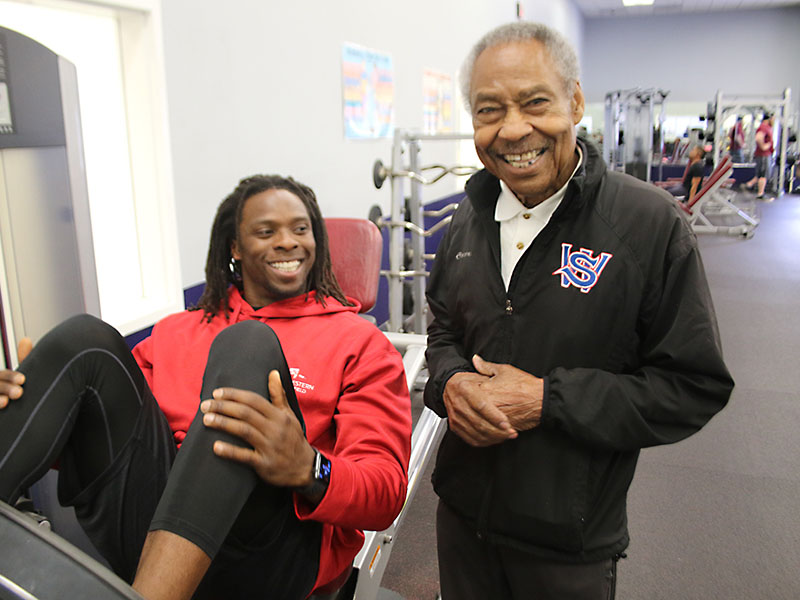
Coos Bay, OR – Southwestern Oregon Community College’s Athletic Department is proud to announce the naming of the sand pit on the Laker track after our long-time assistant track and field coach, Kermit Walker. Kermit was the assistant coach in charge of long-jumpers and triple-jumpers during his nearly 20 years of service at Southwestern. During this time, he coached numerous Northwest Athletic Conference (NWAC) champions and All-Americans. Dan Neal, retired Track and Field coach shared that, “Kermit was not just my assistant coach for the jumps, he was an icon in the Oregon track and field community.”
Kermit continued to coach well into his 80’s and even found time to teach part-time for the physical education department. Kermit created and implemented a fitness class for older adults on campus, which he continued to teach even last year while he battled cancer. Kermit has coached numerous student-athletes who love and adore him to this day. But Kermit was also an extremely competitive individual. Kermit himself continued to compete on the national stage in master’s track meets and was at one time ranked #1 in the world for his age group in the triple jump.
Retired Athletic Director John Speasl says of Kermit, “This man is a role model for all of us, the college, students, coaches, and the community, are all better for having Kermit Walker touch our lives.”
The athletic department believes that this small gesture will be a testament to his many years of service and his passion for helping student-athletes. The plaque is designed locally by Action Trophies in Coos Bay and will have his name, years of service and his favorite quote: “Every jumper deserves a perfect pit.” Kermit was known for constantly grooming the pit at SWOCC and even when on the road would take the rake from others to make sure the pit was perfect for all the jumpers during a meet. The plaque will be placed on the outer edge of the pit for the next generation of Lakers to honor Kermit.
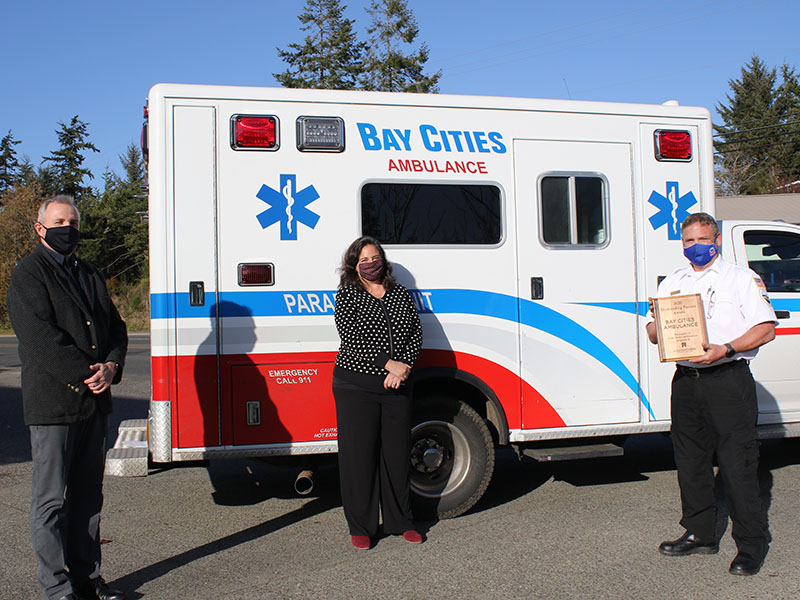
Coos Bay, OR – Southwestern Oregon Community College is pleased to announce that our annual Career Technical Education (CTE) Industry Partner of the Year award for 2020 is Bay Cities Ambulance. General Manager Tim Novotny, and his team at Bay Cities Ambulance have served as an outstanding industry partner for Southwestern’s Paramedic Degree program for many years. In addition to providing highly qualified instructors, Bay Cities Ambulance has provided the college with vital training equipment including the college’s ambulance.
Southwestern students are also able to complete their required field training through Bay Cities Ambulance in collaboration with our numerous community healthcare provider facilities. And, Bay Cities Ambulance serves as a great employer partner with many Southwestern EMT and Paramedics graduates finding successful employment with the ambulance service.
Dean of Instruction for CTE, Dr. Daniel Koopman says, “Like so many vital career technical education programs at Southwestern, our programs of study depend on the generous support and partnership with great companies like Bay Cities Ambulance. Thank you, Tim Novotny and congratulations to the dedicated team at Bay Cities Ambulance!”
To learn more about Southwestern’s career technical training programs visit www.socc.edu, or call 541-888-7371 to make an appointment with an advisor.