Nov 25, 2025 | News, Staff & Administration
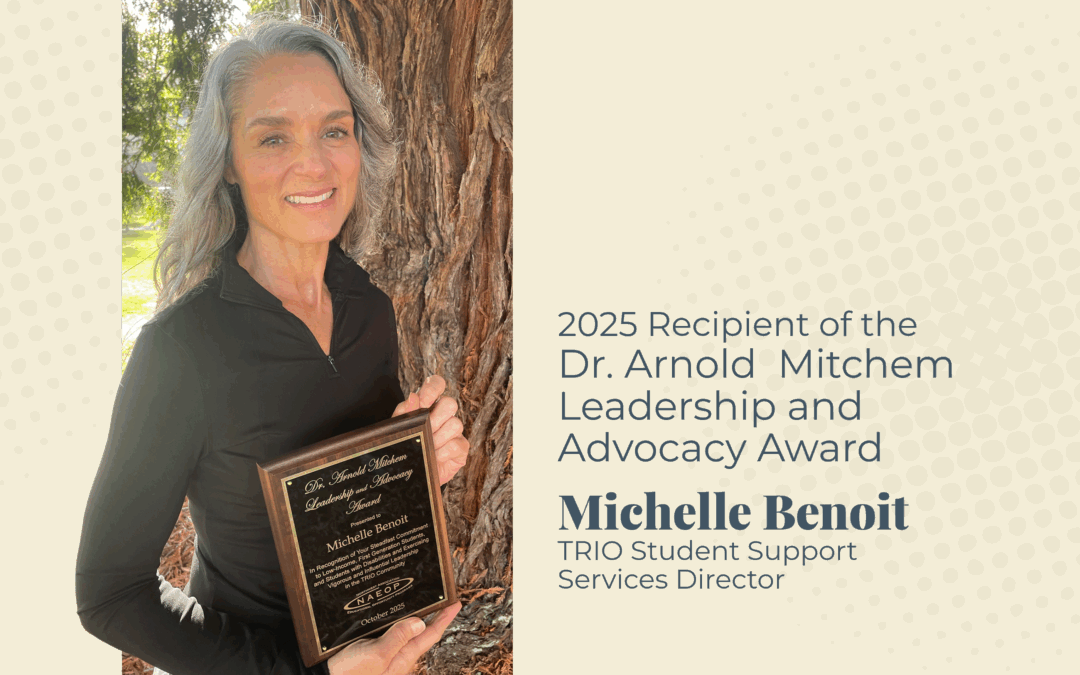
COOS BAY, OR – The Northwest Association of Educational Opportunity Programs (NAEOP) awarded the Dr. Arnold Mitchem Leadership and Advocacy Award to Michelle Benoit, Director of TRIO Student Support Services (SSS) at Southwestern Oregon Community College at its annual conference in October. The award recognizes an individual who demonstrates exceptional leadership and unwavering commitment to serving low-income, first-generation students, and students with disabilities throughout the Northwest region.
The award is named for Dr. Arnold L. Mitchem, the founding president and president emeritus of the Council for Opportunity in Education. Dr. Mitchem is an internationally recognized pioneer in advancing equal educational opportunity and is credited with formulating the concept of “first-generation” students, which was adopted in the reauthorization of the Higher Education Act of 1980. His nearly six decades of advocacy have helped expand federally funded TRIO programs by nearly 400 percent, now serving nearly one million students annually at more than 1,200 colleges and universities nationwide.
Since 2013, Benoit has led the TRIO SSS program at Southwestern, where she has been a tireless advocate for students on her campus and throughout Oregon, the Northwest region, and nationally. Her leadership was particularly vital during her tenure as Oregon TRIO Association (OTA) president in 2020, when TRIO programs nationwide faced unprecedented challenges during the COVID-19 pandemic.
“Michelle is a confident and strong advocate and served her state and region at a time when programs had to quickly pivot and adjust to the changes at their institutions, with their students, and at the federal level,” said Robin Williams, incoming President of NAEOP. Her leadership helped guide programs through one of the most challenging periods in higher education history.
Beyond her campus responsibilities and state leadership, Benoit consistently prioritizes advocacy at the national level and is a regular attendee at the Annual Policy Seminar in Washington, D.C., where she maintains strong connections with Oregon’s congressional delegation, including U.S. Representative Val Hoyle, District 4’s dedicated TRIO advocate.
Benoit’s impact is deeply felt on campus as well. “We are proud to recognize the tremendous work that Michelle Benoit has contributed to Southwestern, where her dedication to supporting and advocating for students has made a lasting impact. With compassion and unwavering commitment, she has helped countless learners navigate the challenges of college. A respected leader on campus, Michelle consistently elevates the student experience through her guidance and example. We are thrilled to see her efforts honored and celebrated,” shared DeAnne Varitek, Dean of Career Technical Education at Southwestern.
Benoit’s influence extends beyond Southwestern. Her commitment to strengthening the TRIO community extends to mentoring other TRIO directors and serving as a NAEOP peer reviewer, helping to ensure program quality and supporting emerging leaders in the field.
“We are very grateful to have Michelle as such a strong leader and advocate in our region,” said Williams. Her dedication to educational opportunity exemplifies the values that Dr. Mitchem championed throughout his career.
“I am deeply honored to receive the Dr. Arnold Mitchem Award. As a first-generation college graduate, I know firsthand the transformative power of education. I am grateful to the students whose resilience and determination inspire me every day and to the TRIO community that continues Dr. Mitchem’s legacy of advocacy and opportunity,” said Benoit.
NAEOP represents professional educators who work with low-income, first-generation, and students with disabilities throughout Alaska, Idaho, Oregon, and Washington. NAEOP provides a venue in which all TRIO and similar programs may support the success these students to obtain a quality education. NAEOP provides support services and opportunities not normally accessible to these populations to help them reach their full potential and develop into professional individuals.
TRIO Student Support Services (SSS) is a federally funded program that provides select students with free academic support services designed to help them succeed at Southwestern. To learn more visit our TRIO webpage.
Aug 19, 2024 | Alumni, Community, News, Staff & Administration
Inspiring tomorrow’s firefighters, paramedics, food producers, and dental professionals
Southwestern is pleased to deliver year after year on our 64-year commitment to provide our students with exceptional teaching and learning environments.
Come fall term, we will celebrate completion of a $5.5 million project to modernize 18,240 sq. ft. of space in historic Coaledo Hall and nearby Sumner Hall on the Coos Campus. This project culminates five years and $43 million of infrastructure investment to update buildings, energy systems and teaching space on both the Coos and Curry Campuses.
Built in 1965, Coaledo Hall served as the College’s science lab building until it was taken out of service in 2021 with the opening of advanced laboratories in Umpqua Hall. Today, Coaledo will become a new flexible learning space with technology-rich labs for Forestry and Agroecology.
The development closes the loop on creating a holistic center for Forestry and Agroecology students. They now can move with peers between collaborating in the classroom environment to working in the campus’ urban forest/wetland environment and food production gardens.
A renovated Sumner Hall nearby, the site of former nursing labs, remains dedicated to training tomorrow’s allied health professionals. It will serve as the home for a re-envisioned Dental Assisting program and an ambulance simulation lab and classrooms to serve students pursuing careers in Fire Science, EMS and Paramedicine.
Overall, this work helps the College hire and retain highly skilled faculty. It ensures residents from the south coast have access to more affordable college education and high-skill job training equivalent to that offered in metro areas. Ultimately, the result is a more stable workforce, and economically healthier communities and families.
This current project was funded with a $2.75 million capital grant from the Oregon Legislature matched with $2.75 million in grant funds from the U.S. Economic Development Administration.
Julie Ryan

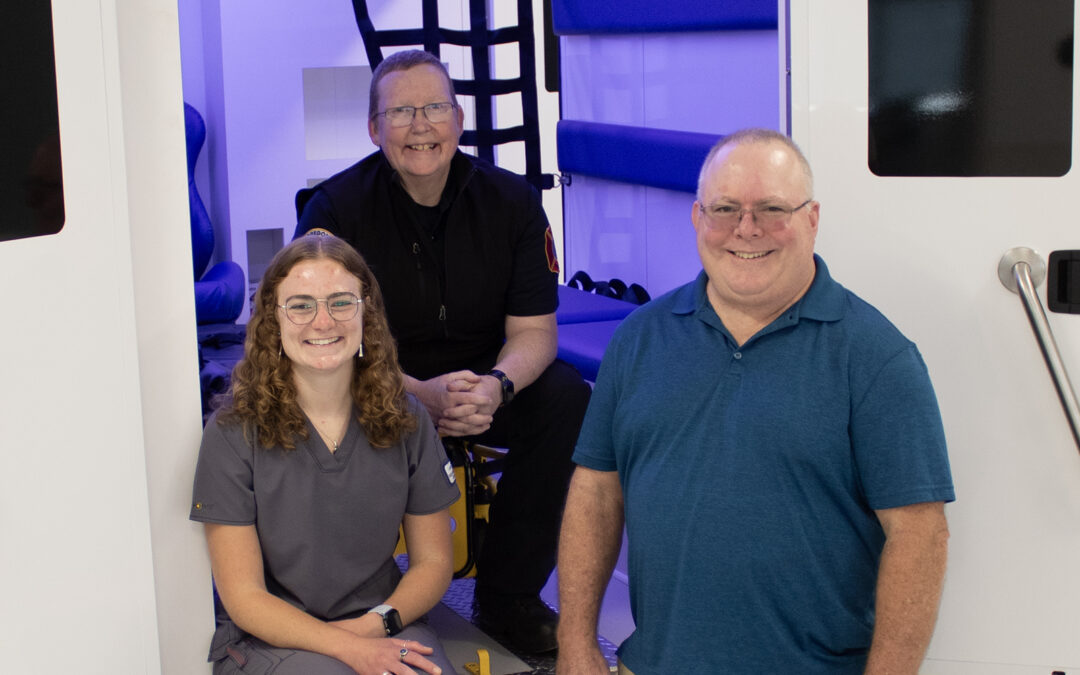
Julie Ryan returns to Southwestern as the EMS Program Director and Assistant Professor of Paramedicine. She holds a bachelor’s degree from Linfield University and is a Nationally Registered Paramedic and an Oregon Licensed Paramedic. Previously she was a member of the Reach and Treat Team, providing advanced life support and technical rescue in wilderness environments, and holds Rope Rescue Technician and Advanced Swift Water Rescue certifications. Ryan served as a Flight Paramedic, a Paramedic for Bay Cities Ambulance, and most recently as a Firefighter/Paramedic for Cascade Locks Fire and EMS. With thirty years of EMS experience, she brings invaluable knowledge and lived experience to the table.
Madi Ogle

Madi Ogle grew up in Sandpoint, Idaho, and attended Boise State University earning an Associate of Science degree. In 2020 she enrolled in SWOCC’s Dental Assisting Program. Madi deepened her love for dental health, excelling in the program, and working as a licensed Oregon Expanded Functions Dental Assistant. While working in the field she was inspired to pursue other career opportunities and progressed through various roles at Southwestern: Campus Store, Student Success Center, and then to the Financial Aid office as the Student Employment Coordinator. Now in her new role as the Dental Assisting Instructor she brings a unique perspective and commitment to the education of dental professionals.
Michael Seldon

Michael Seldon brings over thirty years of career experience in emergency services disciplines including structural/municipal firefighting with the Coos Bay Fire Department, hazardous materials team technician, emergency room trauma technician, and ambulance-based emergency medical technician. He holds certifications in firefighter 1 and 2, fire officer, fire instructor, incident safety officer, vehicle extrication, heavy rescue systems and practices, pumper and aerial apparatus operator, and SCBA maintenance and repair. Seldon earned an Associate of Science degree in Public Fire Service and graduated from the fire academy at Rancho Santiago College in Santa Ana, California. He earned a Bachelor of Arts degree in Mass Media Communications – Radio/TV/Film from Long Beach State University.
Jan 12, 2024 | Community, News, OCCI News, Staff & Administration
Enter the captivating world of competitive ice carving through “From Oregon to Alaska: An ice sculpting odyssey” an Oregon Field Guide exclusive short film profiling Chef Chris Foltz, Chef Instructor here at Southwestern’s Oregon Coast Culinary Institute.
The episode, which aired on Oregon Public Broadcasting on December 7, 2023, showcases Chef Foltz’s artistry, dedication, and passion for the craft. We get a behind the scenes look at this world-famous competition and watch the joy and excitement of the student carvers creating their unique pieces as well.
Regarding the competition, Chef Foltz says, “Alaska, it’s so far away. It costs a lot to get there, it’s an immense amount of work, and then when you get there, all of your work is going to melt away. But as a professional artist, it’s the one place that I get to go and do whatever I want to do.”
Stay tuned for updates as Chef Foltz and a new crop of student carvers prepares for this year’s World Ice Art Championship “Ice Alaska” in February.
Apr 3, 2023 | Community, News, Staff & Administration
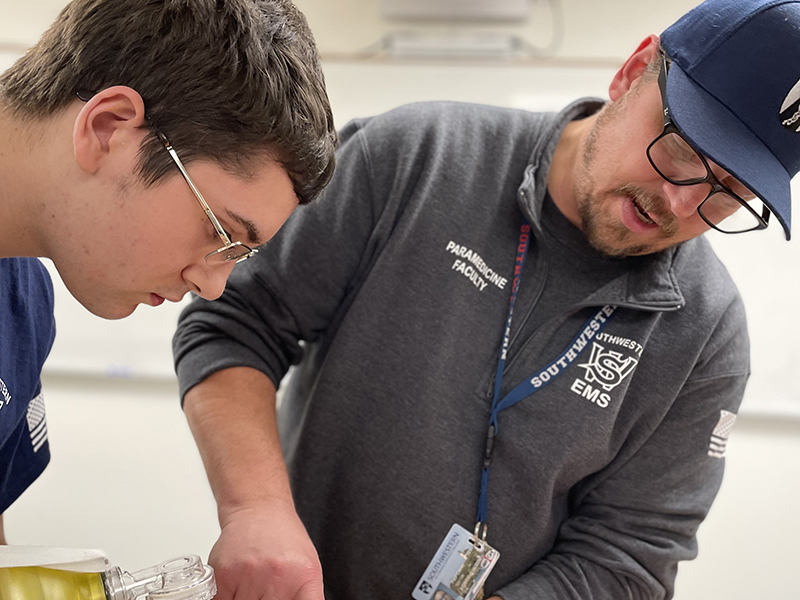
Instructor Paul Casler works with an EMT student
“If you are a person who likes routine, this job is NOT for you.” That’s advice from Southwestern’s Paul Casler, who trains students for jobs as paramedics and emergency medical technicians. Likewise, if you like action and saving lives, this job is for you.
There is a variety of opportunities for EMTs and paramedics. With certification you can find employment in doctor’s offices, emergency rooms, medical clinics, fire departments, and more. No experience is required to enroll in the program, just a desire to help people in crisis.
And, you will get to learn with Casler. He spent 15 years as a paramedic in Denver. Then one day he realized his best days on the job involved working with students. He was ready for a change and decided to pursue his love of teaching. Impressed by Southwestern’s support and commitment to the EMS program, Casler joined the faculty last fall.
“I believe in the community college model for entering the profession. Getting that degree is crucial,” he said.
There is a lot of interest in emergency medical careers after the recent emergency when football player Damar Hamlin collapsed on an NFL field is causing a buzz around the profession. Casler is hoping it inspires people to consider this career pathway and to come to Southwestern. The U.S. Bureau of Labor and Statistics projects a 9% increase in the job market for EMTs and paramedics over the next several years.
“If you have a certification, you will have a job!” Casler said. “There’s a huge need in this community.”
To learn more about EMS degrees at Southwestern visit: www.socc.edu/ems.
To learn more about all our programs text or call 541-240-8227; email: SWOCCbound@socc.edu.
Mar 10, 2023 | Staff & Administration, Student Success
Dear Campus Community,
Southwestern is Oregon’s most remote community college. Most of us may not think about the implications of that. For people who want to go to college, we are the only local option.
To learn elsewhere, residents of the college district must travel over a mountain range or go online. Often, it is more expensive. Many students want the “people connection”, and 50% of our students who enroll in CTE programs need access to labs and equipment, usually requiring time on either campus.
Yesterday, I and seven other community college presidents testified before a legislative higher education committee. One after another, we talked about our students, the challenges they face and the groundbreaking work community colleges do. We did not talk about community college funding, but it was the unspoken topic in the room as the Legislature works on the state’s budget. Here is the link if you want to watch it. https://olis.oregonlegislature.gov/liz/mediaplayer/?clientID=4879615486&eventID=2023031097
Oregon funds 38% of our budget through reimbursement on a three-year lookback of FTE enrollment. Local property taxes provide 32% of the college’s revenue. Tuition and fees cover 27%. The other 3% is miscellaneous funding.
When the governor and lawmakers let community college funding stagnate, our costs still go up. Property tax increases are capped at 3% annually, so in times of high inflation colleges are left with few options to balance revenue with escalating expenses. The options then become increasing tuition and fees, and cutting expenses. We can’t raise tuition and fees enough to make up for what we need.
Budgeting at the end of a biennium is an analytical guessing game. As the college works on the budget now through April, it’s unlikely the state will finish its work until June. We don’t know at what level the state will fund colleges. We do know, though, the next two years of funding probably will not cover projected costs for current operations.
Changing Demographics
In this region, the population is shifting rapidly. There are fewer younger people and many more retirees. Enrollment at Oregon’s colleges is projected to decrease through 2029. Rural colleges are hardest-hit. Yet, colleges are expected to provide more services to help students persist, overcome and complete.
If you have taken an economics class, you know there is a point as enrollment decreases, it becomes more expensive per student to operate. Every day we work on the operational challenges of maintaining buildings and grounds. We try to hire and inspire staff in a competitive, worker-shortage era.
Yesterday in the legislative hearing, I put my budget worries aside and focused on the work we do that inspires. I talked with lawmakers about how Southwestern has transformed developmental education and become a leader in the state for student success.
When I started here at SWOCC 30 years ago as a faculty member, a student might have taken 37 credits of developmental reading, writing and math before ever taking a class on their pathway to a degree or career. Most students gave up. National data shows that only 23% completed degrees or certificates if they start in a developmental class for credit.
In the early 2000s, we set out to change that. Southwestern became a pioneer in the Guided Pathways movement. We joined with Achieving the Dream in 2012. This led us down a path to improve developmental reading, writing and math curriculum. Today, the college is a leader in student completion.
Achievement
Students on our campuses at that time took a placement test where 50% needed basic help in reading and writing. 80% of our students needed a developmental math refresh. Not sure how those statistics have changed over the years. What has changed is how the college teaches those students.
Starting in 2011, we began conversations with faculty to improve the pathway to completion. We began by re-engineering classes and linking students with the math they need based on their pathways in STEM or non-STEM. We eliminated many developmental classes by improving curriculum or creating “co-requisite” classes.
After 12 years, our data shows success. Southwestern’s students reach their degrees 1 year sooner than all the other students at Oregon’s other community colleges. The four-year completion transfer rate is 65%, which 14% points higher than the other community colleges. Eleven percent of our students are LatinX. Their completion success at 67% is higher than any other group at this college, and 21 percentage points higher than any other college in Oregon. These are amazing outcomes and it has gotten the attention of lawmakers and others around the state.
Every time I drive home after spending time with the other college presidents, I am so happy to be at SWOCC. We have an awesome college with awesome faculty and staff. I am so proud to be your leader. Sure, we have some challenges to sort through so let’s remember that we are a team of people who might have some different opinions on how we move forward to reach our strategic priorities. But let’s try to be mindful that it takes all of us to work together to improve student success.
Have a great weekend,
Patty
Patricia M. Scott, Ed.D.
President
Southwestern Oregon Community College
Mar 2, 2023 | Community, Curry Campus, News, Staff & Administration
Coos Bay, OR – Southwestern Oregon Community College’s Physics and Engineering Department is pleased to present Access Granted: Science Education and Research Achievements while Overcoming Limitations, a discussion of scientific access for students facing health and educational challenges and limitations. The lecture will take place on Thursday, March 9, 2023 at 6:30pm in the Umpqua Hall 184 lecture room on the Coos Campus (1988 Newmark Ave., Coos Bay).
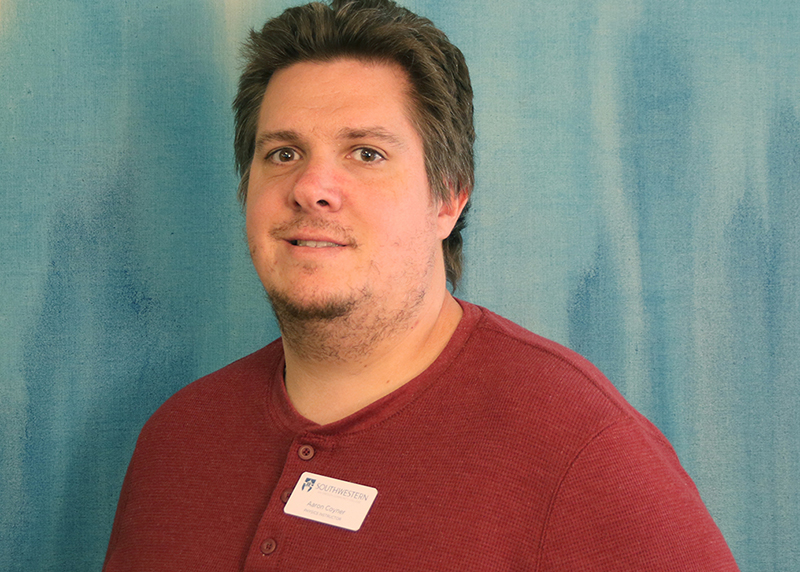
Our presentation is timed to coincide with March being National Cerebral Palsy Awareness Month and will feature a presentation from our own Dr. Aaron Coyner, Associate Professor of Physics and Engineering at Southwestern. Dr. Coyner will be showcasing achievements and discoveries by notable scientists like Stephen Hawking and Annie Jump Cannon, among others, while discussing changes that can be made to increase the accessibility of scientific opportunities.
The talk will be streamed live for those who cannot come to campus. Access the live stream via our website (www.socc.edu) or at this link:
https://livestream.com/swocc/physicsandastronomy2022-23.
For students and community members in Curry County (and beyond) a Zoom link will be available so that you may participate in both the lecture and Q and A following the talk. For zoom participation information contact Dr. Aaron Coyner at aaron.coyner@socc.edu.
For more information about the lecture series contact Dr. Aaron Coyner, Associate Professor of Physics, at 541-888-7244, aaron.coyner@socc.edu.
To learn more about physics and engineering degrees at Southwestern visit https://www.socc.edu/physics/.